Attention vs connection. Why the newest apps win your eyes, and the oldest matching wins your heart.
Modern dating apps are built to hold your attention. Nakshatra matching, one of the oldest tools in Vedic astrology, was built for something else: two people who actually fit. Here is the difference, and why it matters.
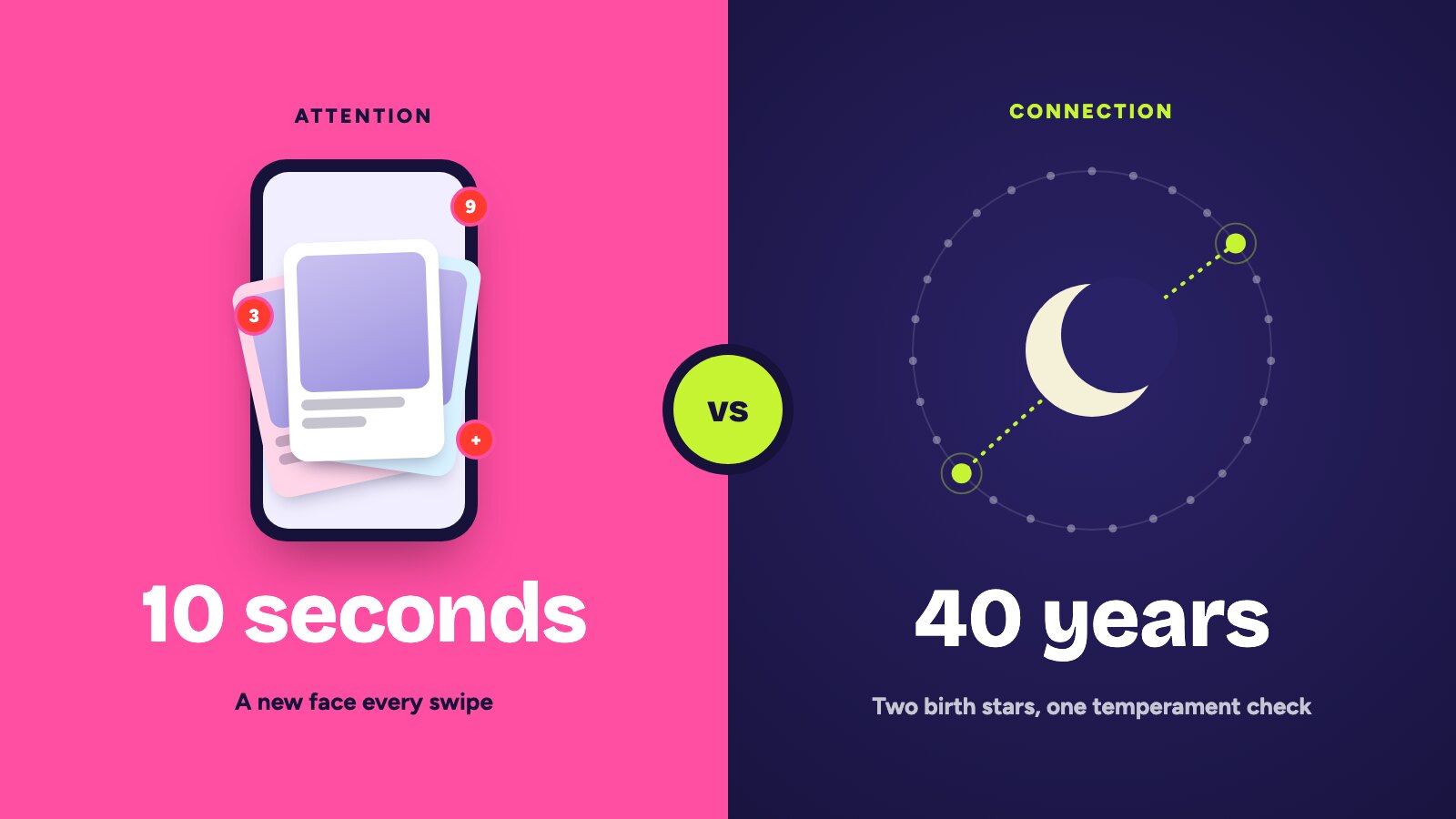
Open almost any dating app tonight and it will work hard for you. A new face every second. A red dot when someone likes you. A notification at exactly the hour you are most likely to be bored. It is very good at one thing, and that thing is attention.
Attention is not the same as connection. You can spend a month on an app, match with forty people, and not have one conversation that made you feel understood. Most people who have used these apps know that feeling. The app was busy. You were busy. Nothing happened.
This post is about that gap, and about an old tool that was built for the other side of it.
What the newest apps are built to do
Most modern dating apps measure success the way a social feed does: how often you open it, how long you stay, how many times you swipe. Those numbers are easy to grow. Show more faces. Make the next one feel one tap away. Reward the swipe, not the conversation.
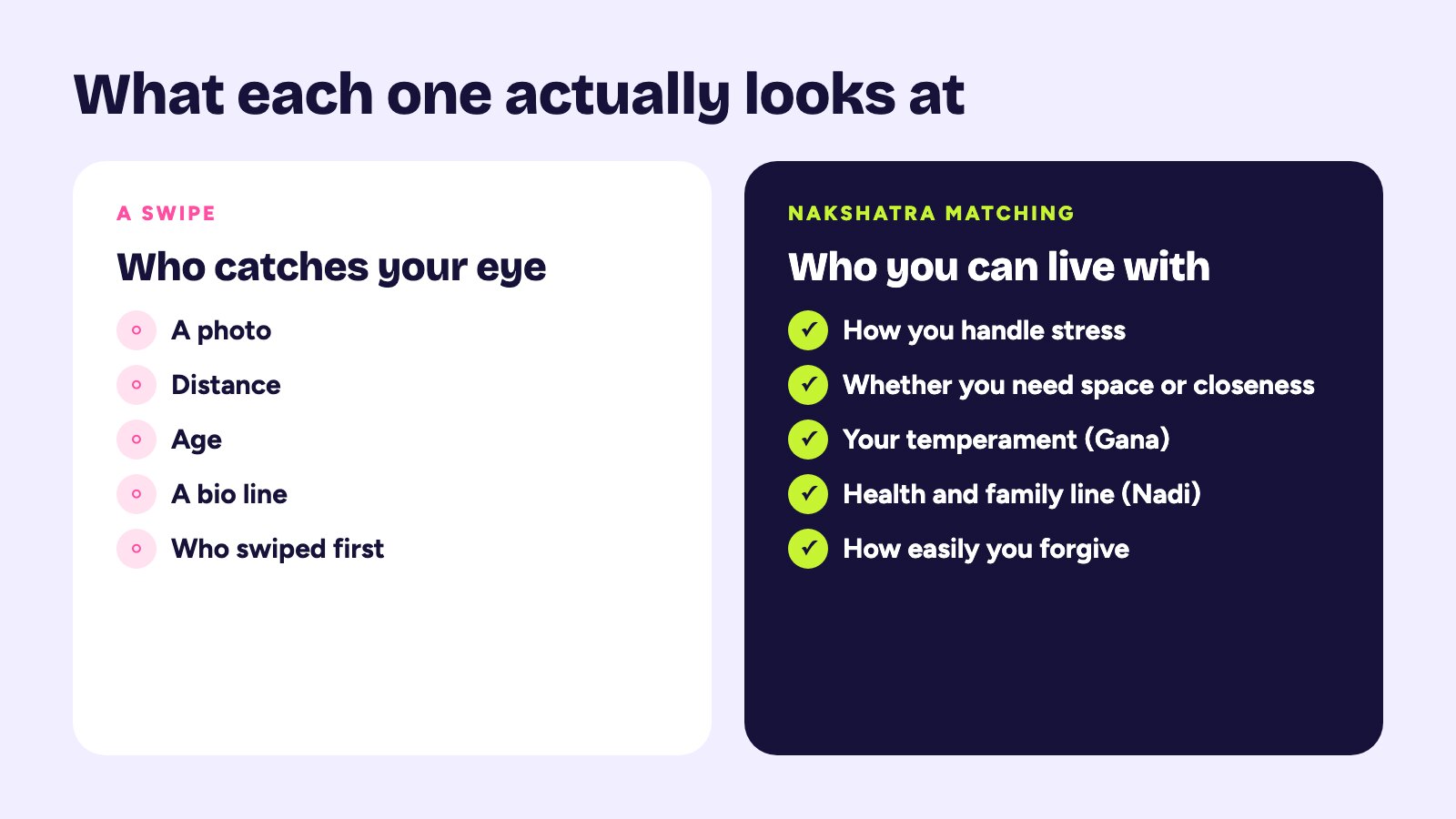
None of that is evil. It is just a design choice, and the choice shapes what you get. An app built for attention will give you a lot of people, very quickly, chosen mostly by a photo and a distance. It cannot tell you whether the person on the screen will understand you when you are tired, or how the two of you will argue, or whether your temperaments will settle into each other or rub.
A photo tells you who catches your eye. It tells you almost nothing about who will hold your hand at 2 am in a hospital waiting room.
What Nakshatra matching looks at
Long before there were apps, families in India had a different question when two people were introduced. Not "are they attractive" but "will they be good for each other". One of the oldest tools for that question is the Nakshatra.
A Nakshatra is the lunar mansion the Moon sat in at the moment you were born. There are 27 of them, each about 13 degrees of the sky. In Vedic astrology the Moon stands for the mind: your moods, your instincts, how you feel safe, how you react when something goes wrong. So your Nakshatra is less about your public personality and more about your inner weather. If you want the full picture, we wrote a primer: What is a Nakshatra?
When two charts are matched, the Nakshatras of both people feed the Ashtakoota system, eight checks scored out of 36. Several of those checks are really about emotional fit:
- Tara looks at how the two birth stars sit relative to each other, a read on wellbeing and luck together.
- Yoni describes instinctive nature and physical compatibility.
- Gana sorts temperament into three broad types, and asks whether yours and theirs can live in one house.
- Nadi is the one families watch most closely, tied to health and to the next generation.
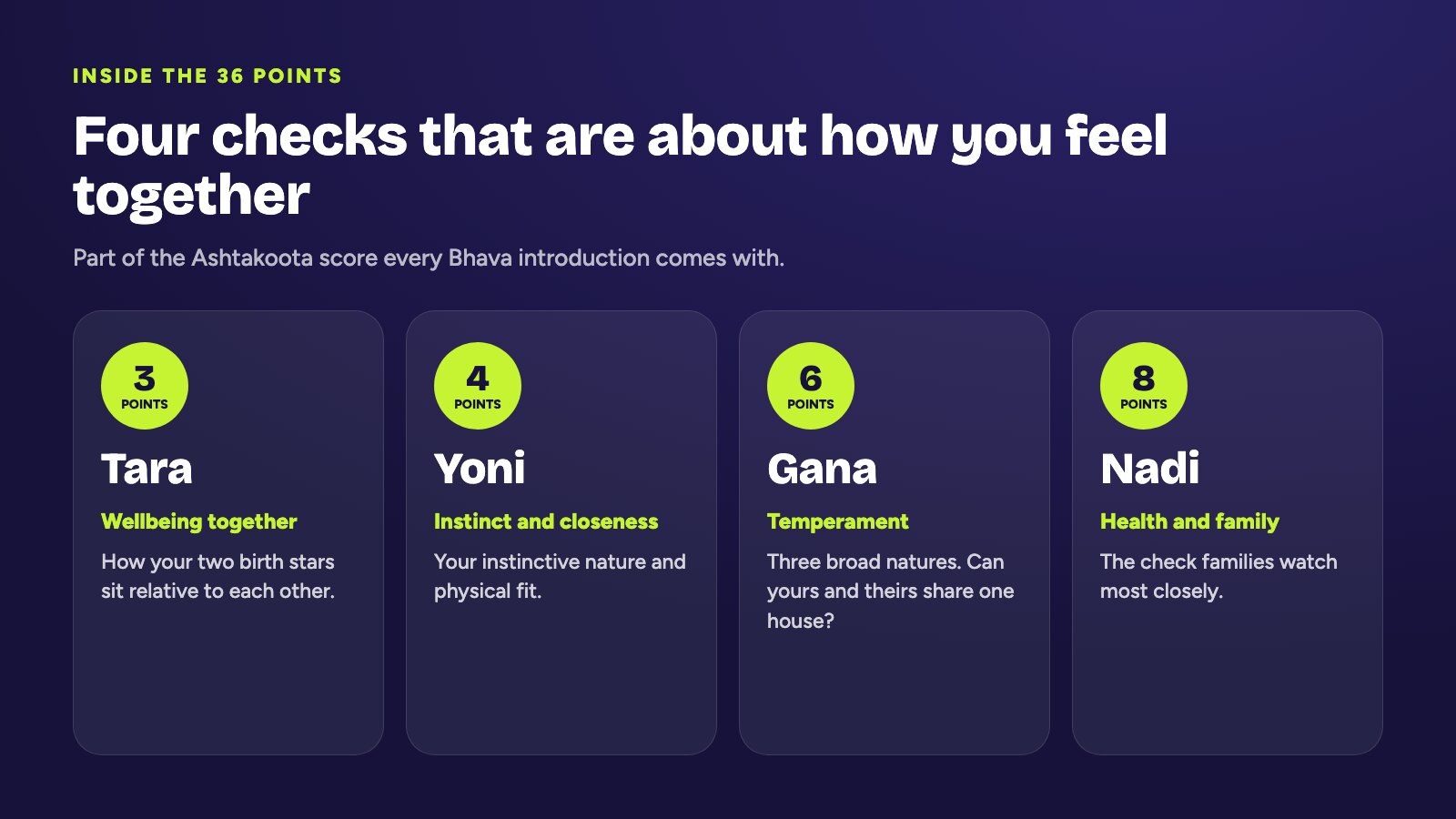
Read together, they answer a question no swipe can: how will these two people feel around each other, day after day? We explain each of the eight in plain language in What is Ashtakoota Milan?
Attention fades, temperament stays
Here is the simple version of why this matters.
The things that grab attention change fast. A great photo, a clever opening line, a shared song. They are real, and they are fun, and they fade within weeks.
The things Nakshatra matching looks at do not change much at all. How you handle stress. Whether you need space or closeness when you are upset. How quickly you forgive. These are the things couples say, years later, made the marriage work or made it hard. They are also the things you cannot see on a profile.
That is the trade. The newest apps optimise for the first ten seconds. The oldest matching was built for the next forty years.
What it is not
Nakshatra matching is not a verdict, and it is not a promise. A high score does not guarantee a happy marriage, and a lower one does not doom it. Plenty of couples with modest scores do beautifully, because they talk, they understand their differences and they choose each other anyway. We wrote about that honestly in Your chart is not a verdict.
Think of it as a very old, very well-tested conversation starter. It tells you where you will fit easily and where you will need to work. That is more than a photo will ever tell you.
How Bhava puts the two together
We built Bhava because we did not think you should have to choose between a modern app and the wisdom your family trusts.
So the app is modern where it should be. Every member passes a live face check before anyone sees them. There are no endless feeds: each evening you get the Drop, a few curated introductions picked for you, not a stack of strangers to swipe through.
And the matching is old where it should be. Every introduction is matched on your Nakshatra and scored on the full Ashtakoota system, with the doshas flagged, before you ever say hello. You see the score and what each check means up front, so the question your family would ask after six months is answered on day one. Here is the detail: How matching works.
The result is fewer people, chosen for a reason. Less attention, more connection.
If that sounds like what you have been looking for, see how Bhava works.
Bhava notes
One good read on Kundali and marriage, once a month.
An essay or a guide in your inbox each month. No promotions. Unsubscribe in one click.